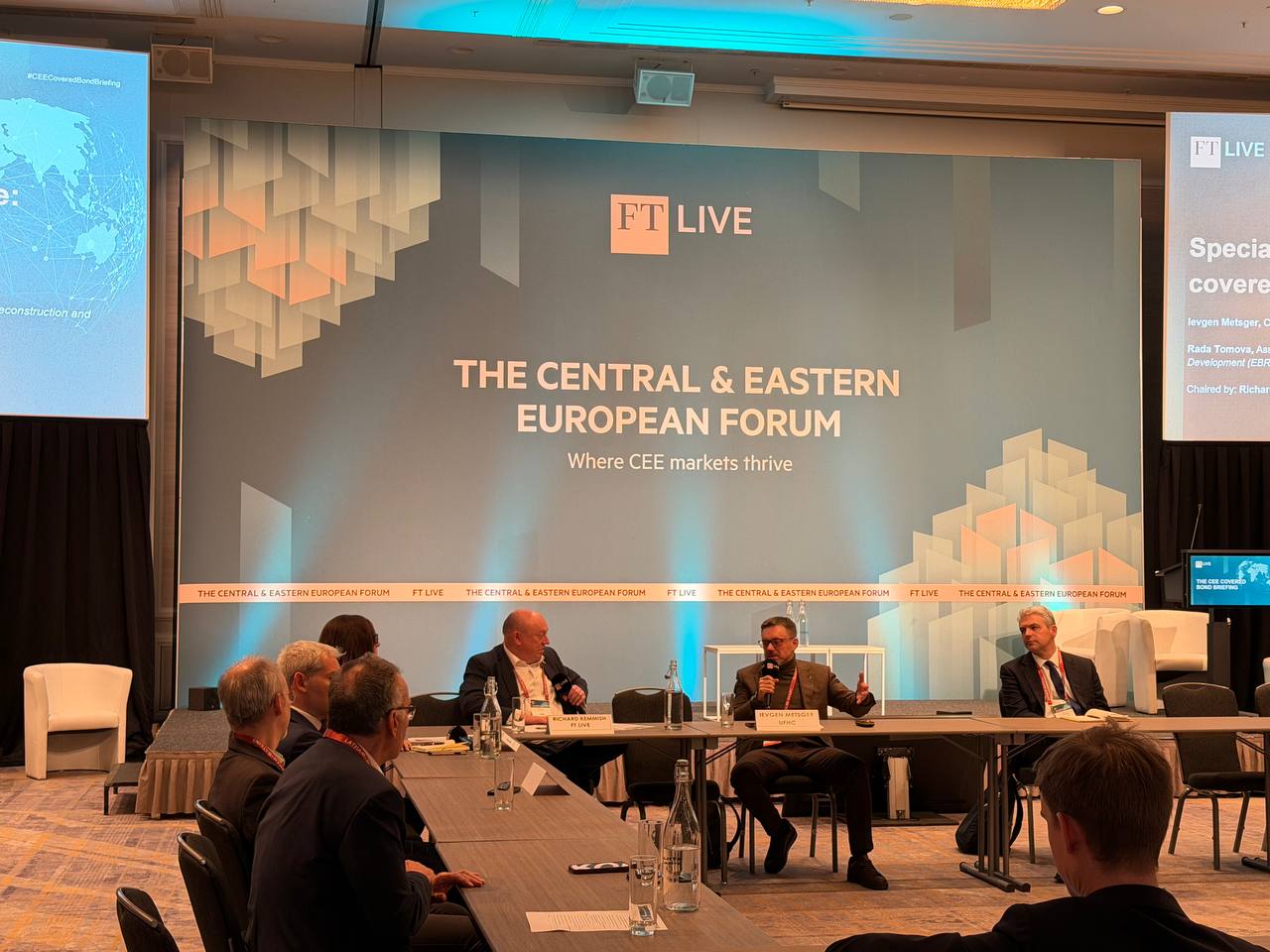
Access to capital markets is a key condition for the long-term development of mortgage lending in Ukraine. While the war continues, UFHC is building the institutional and financial foundations needed to attract market-based funding in the future.
This was stated by Ievgen Metsger, Chairman of Management Board atUFHC, during his speech in Vienna at the special session Rebuilding Ukraine: covered bonds and other tools, held within the Central and Eastern European Forum hosted by the Financial Times. The session was moderated by Richard Kemmish, a leading British independent financial markets advisor, specializing in covered bonds and securitisation. The discussion also featured active contributions from Rada Tomova, Associate Director, Capital Markets Development Team at EBRD, Luca Bertalot, Secretary General at EMF-ECBC, as well as senior representatives of leading European mortgage and banking institutions, including Katarzyna Kurkowska-Szczechowicz, President of Management Board at PKO Bank Hipoteczny (Poland), Matthias Melms, Head of DCM/Syndicate for Financial Institutions and SSA at Helaba (Germany) and Csaba Nagy, Deputy Chief Executive Officer of OTP Mortgage Bank (Hungary)
During his remarks, Ievgen Metsger noted that UFHC’s model was designed from the outset with future access to capital markets in mind. Today, UFHC acts as a systemic institutional platform for the development of Ukraine’s mortgage market and is the sole operator of the state affordable mortgage programme yeOselia.
UFHC’s strategic goal is a gradual transition from a subsidised mortgage model to a market-based mortgage system with access to capital markets. In the post-war period, the company plans to attract long-term funding through:
- securitisation of the mortgage portfolio;
- issuance of covered bonds.
Until the necessary conditions are in place, UFHC relies on interim financing tools that already operate today, including:
- portfolio guarantees;
- guarantees from international financial institutions;
- other mechanisms that support the continuity of mortgage lending.
Ievgen Metsger also emphasised that plans to issue bonds and securitise mortgages are set out in UFHC’s development strategy, approved as part of Ukraine’s memorandum with the IMF. In parallel, the company is considering launching a domestic pilot project involving the issuance of hryvnia-denominated bonds secured by a mortgage portfolio for Ukrainian insurance companies. This pilot would help test the instrument in practice and prepare the market for the full rollout of covered bonds in the future.
An important role in preparing for engagement with capital markets is played by the Advisory Council on Housing Finance under the Ministry of Economy of Ukraine, established in partnership with EMF and ECBC. This platform enables Ukraine and UFHC to systematically adopt the apply international practices in the field of housing finance.